Conventional research treats semiconductors, robotics, space, and critical materials as four related but distinct industries. Each has its own analysts, benchmarks, and commentary, and each is covered in isolation from the rest. The division is administrative. It describes how the research business is organised, not how the technologies behave.
Together, the four behave as one system. They draw on the same inputs, sell to overlapping customers, and break under the same constraints. A change in one shows up in the others, carried by supply contracts and capital flows. Robotnik's founding claim follows from this: frontier technology is a single, definable, investable asset class, and its most important facts surface only when the four sectors are viewed as a whole. Read them apart and those facts stay hidden: the cross-sector shocks, the shared chokepoints, the places where value and risk concentrate.
One system, not four sectors
The stack coheres for physical reasons, not thematic ones. The advanced chips that run a humanoid's perception system also run a satellite's onboard processing. The rare-earth magnets that turn a servo motor also turn a reaction wheel. The lithography tools, specialty gases, and packaging substrates upstream of a memory chip are upstream of a robot's sensors and a satellite's payload. At the point of sale these products have nothing in common. One layer down, they share a supply chain.
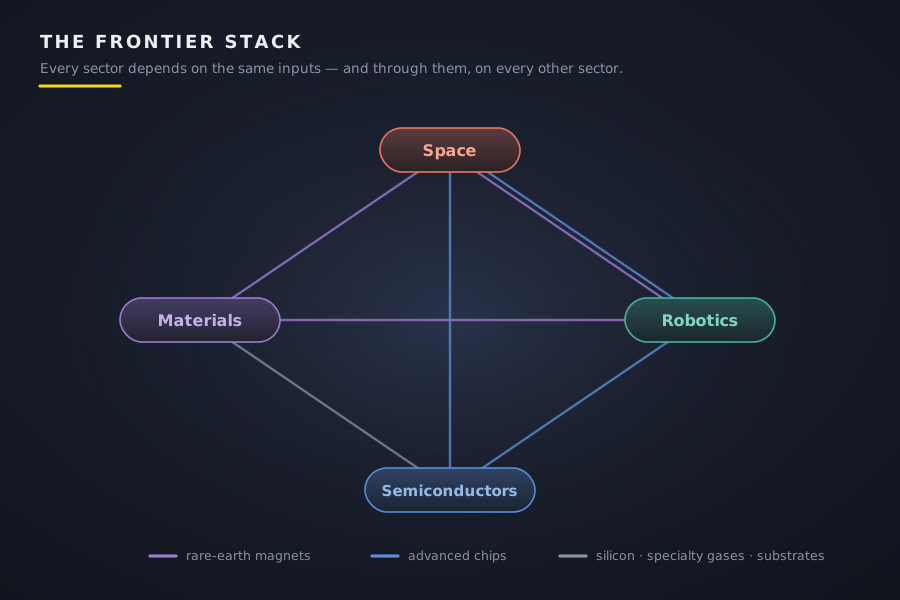
Shared inputs carry shared shocks. A squeeze on magnet supply raises costs for robot makers and satellite builders at the same moment and for the same reason. A wave of fab construction pulls demand through materials suppliers and the automation firms that fit the fabs out. Read one sector at a time, these look like unrelated events. Read across the stack, they are one mechanism: dependency. The transmissions between the layers are where the system shows itself.
An asset class, not a theme
A theme is a story about the future. An asset class is something you can define, price, and measure today. The difference matters. You cannot falsify a theme or hold it to a number; you can hold an asset class to an index that either behaves as the thesis predicts or does not.
The frontier stack is the second kind of thing. Membership follows an explicit rule. The constituents trade at observable prices. Their behaviour can be benchmarked against the market. The rest of the Robotnik library exists to make that work in practice: the universe methodology that draws the boundary, the index family that measures the stack, the entity intelligence beneath both. The thesis is built to be tested, and the record will show where it fails.
The lens: control points
That the stack is one system tells you what to watch. It does not tell you where, and the where matters, because value and risk are not spread evenly. Both concentrate at control points.
A control point, also called a bottleneck, is a position in the stack where three things hold at once: supply sits in few hands, the function is hard or impossible to substitute, and a disruption there passes downstream into everything that depends on it. A node like this earns pricing power and strategic leverage when conditions are calm and transmits the shock when they are not. The place that captures the most value is the same place that is most fragile.
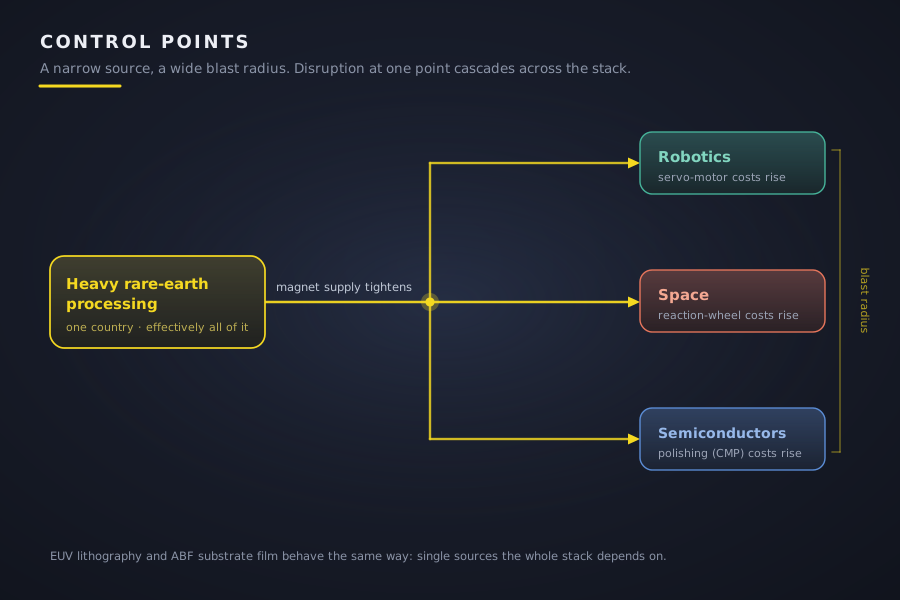
Three examples show how concentrated this gets, and how unalike the chokepoints can be. ASML builds every extreme-ultraviolet lithography system on Earth, the machines that pattern the most advanced chip layers; neither Nikon nor Canon ships one, and the next-generation High-NA tools are ASML's alone. China separates roughly 90 per cent of the world's rare earths and effectively all of the heavy ones, while the United States has no commercial-scale processing for the heavy elements, dysprosium and terbium, that high-temperature magnets need, and buys them almost entirely from China. And nearly every advanced chip package is built on a film made by one company, Japan's Ajinomoto, whose own executives put its share near 95 per cent. A machine, a processing step, a consumable material: three unlike chokepoints, each sitting where its failure would reach the whole stack downstream.
The control point is rarely the company everyone watches. More often it is a specialised supplier several steps upstream, which is exactly why its importance is easy to miss and easy to misprice.
These are not hypothetical risks. China has shown it will use export licensing over heavy rare earths as a policy lever. A control point concentrates strategic power, not only supply.
Control points, not market value or headline names, are how Robotnik locates where value and risk actually sit. The bottleneck methodology turns this definition into a graded criticality score, applied to each entity.
The pure-play boundary
To see the stack clearly, the worst instrument is the set of companies most investors already own. The largest technology firms all touch the frontier, but for each of them it is a sliver of a diversified business, and the share price moves on everything except that sliver. Buy one of them and you have bought a conglomerate that does a little frontier work.
Alphabet is the plain example. Advertising is roughly three-quarters of its revenue. Its entire autonomy-and-robotics effort, Waymo, sits inside the "Other Bets" line and runs well under one per cent, a share that shrinks as the rest of the company grows. Buy Alphabet to own the frontier and you have, in the main, bought an advertising company.
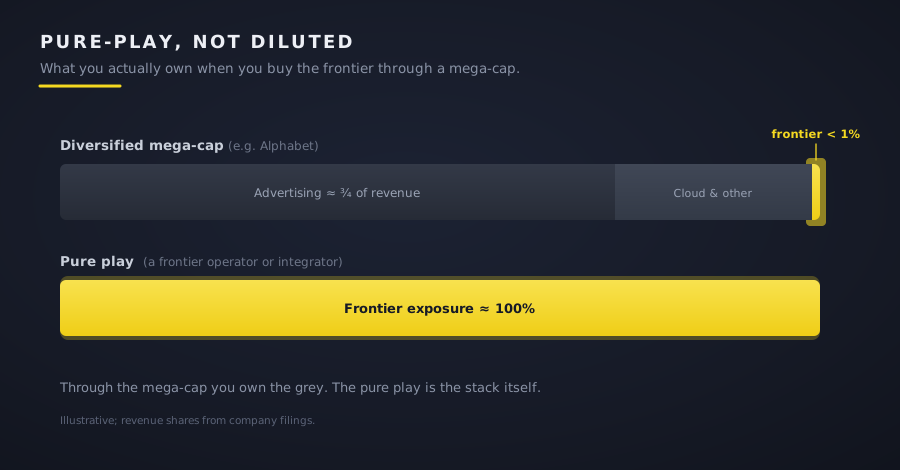
A pure play is the alternative: a company whose business is the frontier, an operator or integrator for which these technologies are the whole enterprise. Only those reflect it without distortion. So Robotnik draws a hard boundary: operators and integrators in; diversified mega-caps, defence conglomerates, and horizontal platforms with incidental exposure, out. This thesis sets out why the boundary matters; the universe methodology sets out how it is drawn, down to the core-business test and the rules for entering and leaving.
Why this view is uncommon
The reason the system goes under-observed is structural. Research is organised by vertical because the banks and firms that produce it are organised by vertical. There are first-rate semiconductor analysts and first-rate space analysts, but each one's brief ends at the edge of a single layer. The dependencies that run sideways, beneath every frontier category, fall into the gaps between those briefs, where no desk owns them. Even the best cross-sector work tends to trace one vertical's value chain in depth rather than the substrate shared by all four.
Robotnik's conviction is that the most valuable facts live in exactly those gaps: the magnet that limits both a robot and a satellite, the chip that drives both, the export decision in one capital that reprices four sectors at once. A view down one vertical misses them. A view across the stack is built to catch them.
Where the frame could fail
A frame this confident should say where it breaks. The frontier stack described here is the current structure, not a permanent one. A technology transition could reroute the chain: a move away from rare-earth magnets in motors, a process that removes a chokepoint, a substitute for a material everyone now depends on. A geopolitical rupture could fracture the shared supply chains into regional blocs, so that one system splits into two. The thesis is a claim about how the stack behaves now, held until the evidence says otherwise. When the structure shifts, Robotnik's task is to mark the change, not defend the old map.
The commitment
A worldview is worth only the discipline it imposes. The frontier-stack thesis commits Robotnik to four things: to set the universe by an explicit rule rather than by feel; to publish indices that can be checked against their own history; to map dependencies entity by entity, not sector by sector; and to record, each quarter, where the framework got it wrong.
The documents that follow carry out that commitment: the universe rule that draws the boundary, the index family that measures the stack, the value-chain taxonomy that places each entity, and the data standard that keeps it all auditable. The thesis comes first because everything else answers to it.
Frequently asked questions
What is the frontier stack?
The frontier stack is semiconductors, robotics, space, and critical materials treated as one investable asset class rather than four separate sectors. They share inputs, customers, and constraints closely enough that a change in one moves measurably through the others, a pattern visible only when the four are read together.
Why are semiconductors, robotics, space, and critical materials a single asset class?
Because they depend on the same inputs. The same advanced chips run robots and satellites; the same rare-earth magnets drive servo motors and reaction wheels. A shock to a shared input such as magnets, chips, or lithography propagates across all four sectors at once, so they behave as one system rather than four independent markets.
What is a control point in the frontier stack?
A control point, or bottleneck, is a position where supply sits in few hands, the function is hard to substitute, and disruption cascades downstream. Examples include EUV lithography (one supplier), heavy rare-earth processing (one country), and ABF substrate film (one firm). Value and risk concentrate at these points.
Why does pure-play exposure matter?
Large technology firms touch the frontier, but it is a small fraction of a diversified business, so their share price reflects the conglomerate rather than the stack. A pure play, a company whose business is the frontier, gives an undistorted reading. Alphabet's frontier work, for instance, is under one per cent of revenue.
How does Robotnik measure the frontier stack?
Robotnik defines the universe by an explicit membership rule, tracks it with a family of indices benchmarked against their own published history, and maps dependencies at the level of the individual entity rather than the sector. The methodology is published, and the framework is tested against new data each quarter.
Who is Robotnik for?
Robotnik is for investors and analysts who treat frontier technology as something to allocate to rather than just read about. That spans retail and professional investors who want the structure behind the headlines, and institutional allocators who need dependency and supply-chain analysis at the entity level. It is a research platform, not a data terminal.